How to Optimize Blogs for AI Visibility
TL;DR: More and more people get answers from AI systems instead of clicking through to websites, which is why our blog traffic is declining. If users no longer come to our content, our content needs…

TL;DR: More and more people get answers from AI systems instead of clicking through to websites, which is why our blog traffic is declining. If users no longer come to our content, our content needs to appear in the AI answers they read. Over the past six months, we developed and validated AI Content Guidelines that significantly increase how often our blogs are cited in AI-generated answers. And now there's a tool that applies them for you: the AI Search Optimizer.
––––––––––––––––––––
Why this matters: the 95% don't visit us anymore
People increasingly ask their informational questions directly in AI systems – ChatGPT, Google AI Overviews, Copilot – and get their answer right there, without visiting a website. This is the "zero-click" shift: Forrester reports B2B organic traffic declines of 10–40% year-over-year, and industry analyses estimate ~60% of all searches end without a click.
We see the same on our own websites: organic traffic is down ~20% globally, concentrated in our TOFU content (blogs, resources, etc.). Our BOFU content (solution/domain pages) are actually growing – buyers still find us.
The problem is everyone else. Per the 95/5 rule, only ~5% of our market is ready to buy at any moment; the other 95% are the audience we need to build familiarity with today so we're on their shortlist tomorrow. That 95% used to reach our blogs via Google. Now they ask an AI, and the AI answers them.
So if they no longer come to our content, our content has to appear inside the AI answers they're reading.
––––––––––––––––––––
What we did: from guidelines to proof to tool
1. Measurement – Rankshift. A new tool that tracks our visibility in AI-generated answers: whether we're mentioned, cited as a source, and how much of the answer we own.
2. AI Content Guidelines. Concrete rules that make blogs more likely to be cited by LLMs: start blogs with a TL;DR, use question-based headings with direct answers, keep paragraphs short and structures predictable, use tables, lists and FAQ blocks, back claims with credible sources, add author credentials, etc.
3. Pilot – the proof. Together with three pilot markets, we tested the guidelines on existing blogs and measured the impact in Rankshift. The results show clear improvement:
- Answer Share rose from 10% to 29%.
- AI Visibility improved from 6% to 22%.
- Citation Rate rose from 15% to 42% on average – in Poland from 19% to 72%.
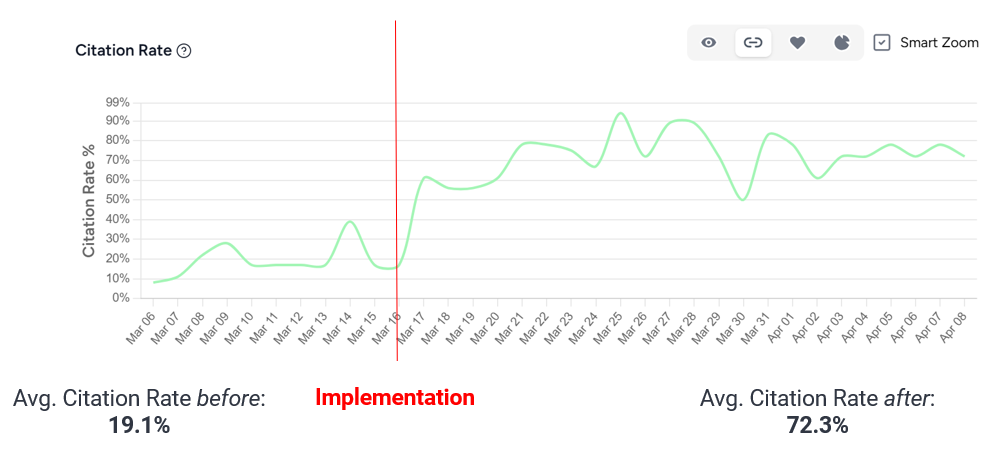
The same blog, restructured according to the guidelines, gets referenced by AI several times more often.
4. Automation – the AI Search Optimizer. Applying the guidelines manually takes time and know-how. So we built an AI assistant that does it for you.
––––––––––––––––––––
The AI Search Optimizer: how it works
Available now in the Marketing Hub. Paste your blog's URL or text, optionally add topic, audience and market, and run it. Within seconds you get:
- The optimized blog – rewritten according to the AI Content Guidelines
- What changed – a summary of every adjustment
- Recommendations – what you should still do yourself (internal links, sources, author info)
- A checklist – what's covered, what's missing
Always review the output before publishing. It's a draft accelerator, not a publish button – small edits are usually still needed.
––––––––––––––––––––
What we recommend
- Run every new blog through the AI Search Optimizer before publishing.
- Prioritize updating your high-value existing blogs – that's where optimization pays off fastest.
Feedback, issues or suggestions? Contact felix.reisacher@sdworx.com.
How did we do?
What is Internal Linking: Actionable Tips and Examples
How to Optimize Google Business Profile